

Qualify for Mortgage with ADU Rental Income
Mortgage, ADU Income, Conventional Loans
Using ADU Rental Income to Qualify for a Conventional Purchase Mortgage
With home prices and interest rates elevated in many markets, buyers are looking for creative, compliant ways to stretch their purchasing power. One strategy gaining momentum is purchasing a home with an accessory dwelling unit (ADU) and using the projected rental income to help qualify for the mortgage. When structured correctly, ADU income can make the difference between “almost qualifying” and comfortably meeting conventional guidelines—without relying on risky assumptions or informal side agreements.
What Is an ADU, and Why Does It Matter for Financing?

An accessory dwelling unit (ADU) is a smaller, self-contained living space located on the same lot as a primary one-unit residence. It can be attached (such as a basement apartment or over-garage suite) or detached (such as a backyard cottage), but it must provide independent living features, typically including:
A separate entrance or clearly defined access
A kitchen or kitchenette with cabinets, countertop, sink, and cooking appliance or hookup
Sleeping area and bathroom facilities
For mortgage purposes, the ADU must be legal or legal nonconforming under local zoning and building codes. Unpermitted units generally cannot be treated as ADUs for qualifying income. When the unit is properly recognized, however, its rental potential can be used to support the borrower’s ability to repay the loan under conventional guidelines.
How Conventional Financing Uses ADU Rental Income for Qualifying
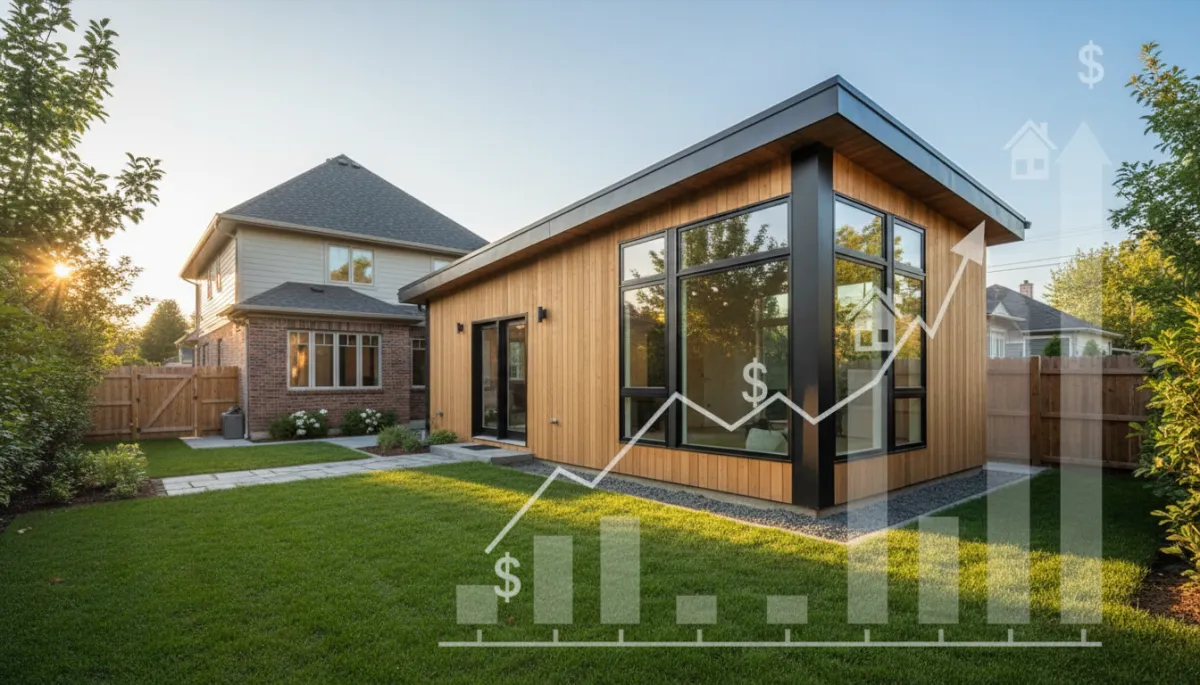
Conventional loans backed by Fannie Mae and Freddie Mac both allow ADU rental income to be included in qualifying income, subject to specific caps and documentation rules. This income is treated as supplemental, not the primary source of repayment, which is why both investors limit how much of it can be counted.
Across both agencies, a consistent theme is the 30% cap on ADU rental income relative to total qualifying income. If calculated ADU income would push the borrower’s qualifying income higher than that limit, the lender must reduce the amount used so that it does not exceed 30%. The excess still may be real income, but it cannot be used for underwriting ratios under these conventional rules.
Purchase vs. Refinance: How ADU Income Is Calculated Differently
Purchase Transactions
For a conventional purchase loan, the lender is typically relying on projected rent rather than a long history of actual collections. To stay conservative, the qualifying income is based on the lower of:
75% of the signed lease agreement amount, or
75% of the market rent shown on Form 1007 (Comparable Rent Schedule)
The 25% reduction is a vacancy and expense factor. If the lease shows higher rent than the appraiser’s Form 1007, underwriting must use the lower figure and then apply the 25% vacancy factor to that lower amount. This prevents overestimating income based on an aggressive lease that the market may not consistently support.
Rate & Term Refinance Transactions
For a rate and term refinance, the focus shifts from projected rent to actual, documented rental history. The default standard is to use the most recent year of tax returns, typically Schedule E, to document net rental income from the ADU. This gives a more realistic view of what the property has actually produced over time, including vacancies and expenses.
If certain qualifying exceptions are met, some lenders may instead use a lease agreement supported by Form 1007, similar to a purchase. Even then, the same principle applies: the lower of the lease or Form 1007 market rent is used, with a 25% vacancy factor applied before the income is included in qualifying calculations.
Documentation Requirements for Using ADU Rental Income
Because ADU income can significantly influence debt-to-income ratios, documentation standards are strict. At a minimum, borrowers should expect the following when ADU income is used for qualifying:
Fully executed lease agreement: The lease should be signed by both landlord and tenant, specify the monthly rent, and typically have a term of at least 12 months. Month-to-month arrangements may be more difficult to use for qualifying.
Form 1007 (Comparable Rent Schedule): Required for purchases and often for refinances where a lease is being used. The appraiser provides a market-based rent opinion for the ADU using comparable rental data. If Form 1007 does not support the lease amount, the lower amount must be used, and then reduced by 25% for vacancy.
Recent tax returns (for refinances): When tax returns are required, the lender will average or otherwise analyze the most recent year of rental income, adjusting for depreciation and other allowable factors according to the agency’s rental income calculation rules.
📌 Key Takeaway: The income you can use is always the more conservative figure—lower of lease or Form 1007, reduced by a 25% vacancy factor, and then limited again by the 30% cap relative to total qualifying income.
Fannie Mae vs. Freddie Mac: Investor-Specific ADU Income Guidelines
Fannie Mae Requirements for ADU Income
Fannie Mae allows ADU rental income on qualifying conventional loans, but layers in several important restrictions tied to the borrower’s housing history and property management experience:
If the borrower has a current housing expense and one-year property management experience: ADU income is limited to 30% of total qualifying income.
If the borrower has a current housing expense but no one-year property management experience: ADU income cannot exceed the lesser of 30% of total qualifying income or the subject property’s PITIA (principal, interest, taxes, insurance, and any applicable association dues).
If the borrower has no current housing expense (for example, living rent-free):no ADU income can be used for qualifying. In that case, the borrower must qualify based solely on non-rental income.
These distinctions are especially important for first-time buyers moving out of a family home or roommates who have not yet carried a housing payment in their own name. Realtors and loan officers should surface this early so expectations around ADU income are realistic.
Freddie Mac Requirements for ADU Income
Freddie Mac also permits ADU rental income for qualifying but adds a specific education or experience requirement and applies the same 30% cap on ADU income as a share of total qualifying income. Key Freddie Mac-specific rules include:
Landlord education requirement: At least one borrower must either complete an approved landlord education course prior to clear-to-close or document at least one year of property management experience. The course is designed to prepare new landlords for screening tenants, managing leases, and handling maintenance and vacancies, which supports sustainable homeownership.
30% income cap: Just like Fannie Mae, Freddie Mac limits ADU income to no more than 30% of total qualifying income. If calculated ADU income would exceed that cap, the lender simply uses a reduced amount that fits within the limit.
💡 Pro Tip for Loan Officers and Realtors: When helping a buyer choose between Fannie Mae and Freddie Mac execution, consider whether the borrower has landlord experience or is willing to complete the landlord education course early in the process to avoid closing delays.
What Happens If ADU Income Exceeds the 30% Cap?
The 30% cap does not mean a borrower must turn away higher-paying tenants. It simply limits how much of that income can be used in the qualifying calculation. If the ADU’s net rental income—after applying the vacancy factor—would make up more than 30% of total qualifying income, the lender will scale back the amount used until it equals 30%. The remaining rental income still helps the borrower’s real-world cash flow, but it cannot be counted for debt-to-income ratio purposes under Fannie Mae and Freddie Mac rules.
Appraisal Requirements for Properties with ADUs
When an ADU is present, the appraisal does more than simply note an extra structure. The appraiser must:
Confirm the existence and characteristics of the ADU, including size, condition, and level of finish, and whether it appears to meet local requirements for an accessory unit.
Provide a Comparable Rent Schedule (Form 1007) to support the market rent used for qualifying when rental income is considered.
Analyze the ADU’s impact on overall marketability and value by using comparable sales with similar ADUs whenever possible.
If the ADU is not fully permitted or is considered an illegal use under current zoning, the appraiser must clearly describe that fact. In many cases, rental income from an unpermitted unit cannot be used for qualifying, even if the structure is physically present and producing rent. This makes early due diligence on permits and zoning critical for buyers, sellers, and agents.
Common Mistakes Borrowers and Realtors Should Avoid
Assuming all rent can be used: Remember the 25% vacancy factor, the “lower of lease or Form 1007” rule, and the 30% income cap. Overestimating usable income can lead to unpleasant surprises during underwriting.
Ignoring landlord education or experience requirements: With Freddie Mac, at least one borrower must complete a landlord education course or document one year of property management experience. Waiting until the last minute to address this can delay closing.
Relying on unpermitted units: If the ADU is not legally recognized, its income may not be usable, and it may complicate the appraisal. Always verify permits and zoning before writing offers that depend on ADU income to qualify.
Overlooking Fannie Mae experience rules: For borrowers with no current housing expense, Fannie Mae will not allow any ADU income to be used. For those without management experience, ADU income may be further limited by the subject property PITIA.
FAQ: ADU Rental Income and Conventional Mortgages
What is a landlord education requirement?
Under Freddie Mac guidelines, at least one borrower must either complete an approved landlord education course or show one year of property management experience when ADU rental income is used. The course typically covers tenant screening, lease management, fair housing basics, and budgeting for repairs and vacancies. It is an underwriting condition, not a licensing requirement, and must be finished before the loan is cleared to close.
What happens if the ADU income is higher than the 30% cap?
The lender will still recognize that the property produces that income, but for qualifying purposes it will only count up to 30% of the borrower’s total qualifying income. Any amount above that threshold is effectively ignored in the debt-to-income calculation, even though it may improve the borrower’s real monthly cash flow.
What appraisal requirements apply to homes with ADUs?
The appraiser must identify the ADU, confirm it functions as a separate living space, and analyze its effect on value and marketability. When rental income is used, a Comparable Rent Schedule (Form 1007) is required to support the market rent. The appraiser should use comparable sales with similar ADUs when available and clearly describe any zoning or permitting issues that could affect eligibility or income usage.
Final Thoughts: Partner Early with a Mortgage Professional
In a high-cost housing market, an ADU can be more than a bonus feature—it can be a strategic tool that helps a buyer qualify for a home that would otherwise be out of reach. At the same time, the rules around ADU rental income are nuanced, and they differ between Fannie Mae and Freddie Mac, as well as between purchase and refinance transactions. Small details like landlord education, property management experience, and the borrower’s current housing situation can dramatically change how much ADU income can be used, or whether it can be used at all.
For loan officers and Realtors, the most effective approach is to surface ADU plans early, review permits and zoning, and coordinate closely with the appraiser and underwriting team. For homebuyers, the best next step is to speak with a licensed mortgage professional who can review your full profile, run the numbers under current investor guidelines, and help you structure a purchase strategy that uses ADU income appropriately and conservatively.
Disclaimer: This article is for educational purposes only and does not constitute legal, tax, or financial advice. Conventional mortgage guidelines, including ADU rental income policies, may change over time and can vary by lender. Eligibility and approval are not guaranteed. Borrowers should consult a licensed mortgage professional to review their specific situation and the most current investor requirements.


