
Avoid Top Mortgage Mistakes for High-Income Buyers
Mortgages, High-Income Homebuyers, Strategy
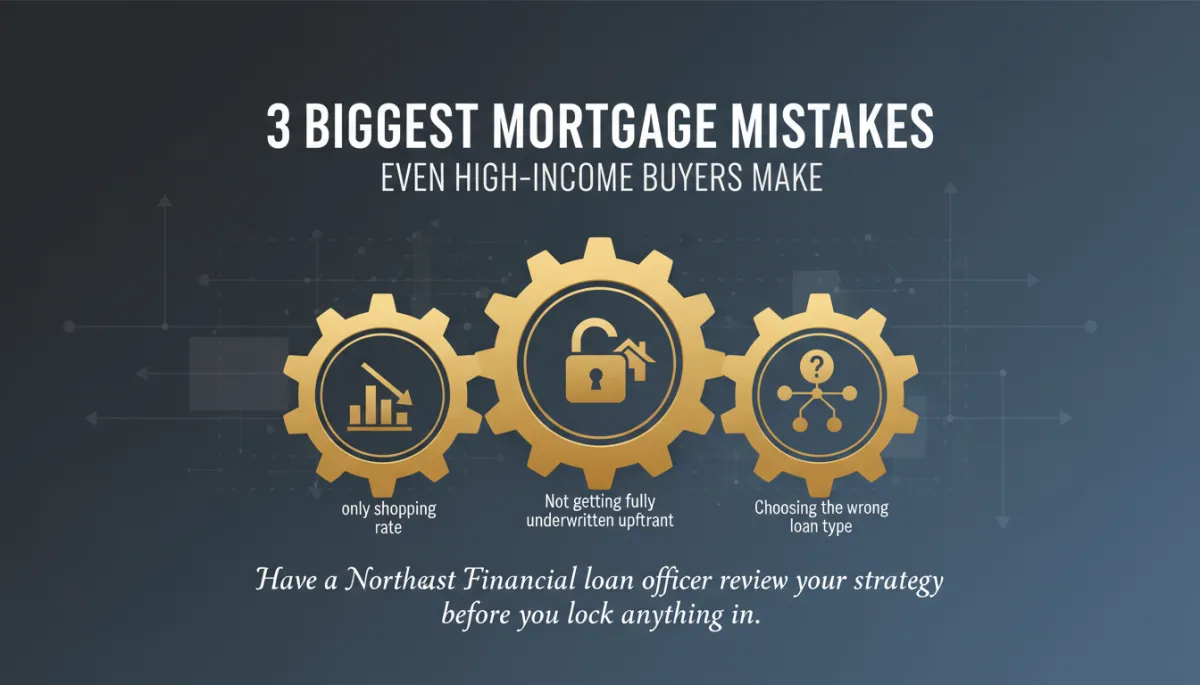
The 3 Biggest Mortgage Mistakes Even High-Income Buyers Are Making Right Now
Earning a strong income should give you an edge in today’s tricky housing market. Yet in 2026, even high-earning professionals are leaving tens of thousands of dollars on the table—and sometimes losing the homes they want—because of avoidable mortgage mistakes. With 30-year fixed rates hovering in the mid-6% range and markets still competitive in many areas, your mortgage strategy matters more than ever.
Why High-Income Buyers Are Still Getting Burned in 2026
In early 2026, average 30-year fixed mortgage rates are fluctuating around 6–6.5%, after sitting above 7% for much of 2025, according to Bankrate and other industry trackers. Analysts from Fannie Mae and other major agencies expect rates to gradually drift toward the high-5% range by the end of the year, but with plenty of volatility along the way. That kind of uncertainty has pushed more builders and lenders to offer rate buydowns, creative incentives, and a wider mix of loan products.
On paper, high-income buyers should be positioned to take advantage of these options. In reality, many are still treating the mortgage like a basic commodity instead of a strategic financial tool. The result: they chase the lowest headline rate, skip critical steps in underwriting, and choose loan types that clash with their long-term plans. These missteps can cost far more than a quarter-point of interest ever will.
Mistake #1: Only Shopping the Rate (and Ignoring Structure, Buydowns, and Strategy)
The most common mistake high earners make is treating the mortgage like airline tickets: open a few tabs, compare the numbers, pick the lowest rate, and call it a day. In a market where average 30-year rates are clustered in a relatively narrow band—around 6.1–6.4% according to recent forecasts—the structure of your loan and the strategy behind it often matter more than a tiny rate difference.
Ignoring temporary and permanent buydowns: With roughly 40% of builders offering rate buydowns or price cuts on new homes, according to industry outlooks, the question is not just “What’s the rate?” but “Who is paying to get it there—and how long does it last?”
Overlooking closing cost trade-offs: A slightly higher rate with $10,000 less in closing costs might be smarter if you plan to refinance when rates dip closer to 5.9%, as Fannie Mae projects could happen by the end of 2026.
Missing lender-specific advantages: Some lenders can close faster, offer more flexible underwriting for complex income, or structure creative buydowns that align with your bonus schedule or stock vesting. Those benefits don’t show up in a simple rate quote comparison.
💡 Pro Tip: Ask, “What are my best three strategies?” instead of, “What is your best rate?” A strategic lender will talk in scenarios, not just numbers.
Northeast Financial works with high-income buyers every day who can technically qualify almost anywhere—but still want the most efficient, tax-aware, and flexible structure. That might mean pairing a slightly higher first-year rate with a seller-funded buydown, or preserving cash for investments instead of overfunding the down payment. The point is not just to “win the rate,” but to build a mortgage that supports your broader financial picture.
Mistake #2: Not Getting Fully Underwritten Upfront—and Losing in Competitive Deals
Many high earners assume their income speaks for itself. They grab a quick pre-qualification letter online and start shopping, confident that their salary, bonuses, and assets will be enough to seal the deal once they find the right house. In a competitive market, that assumption can be costly.
Listing agents and sellers have become far more sophisticated in reading the strength of a buyer’s financing. A basic pre-qualification or even a light pre-approval that hasn’t gone through full underwriting often lands at the bottom of the pile when there are multiple offers—especially if other buyers are coming in with fully underwritten approvals that are essentially “credit-approved cash” offers contingent only on the property.

Fully underwritten approvals often win bidding wars even against slightly higher offers.
This matters even more in 2026 as inventory slowly improves but desirable homes still attract multiple offers in many Northeast markets. With mortgage rates volatile and economic headlines shifting week to week, sellers are prioritizing certainty of closing over everything else. A high income does not guarantee that certainty in their eyes—paperwork does.
Full underwriting upfront means an underwriter has already reviewed your tax returns, W-2s, K-1s, bonus history, RSU or stock compensation, and assets before you even write an offer.
Your approval is no longer a rough estimate; it’s a conditional commitment, subject mainly to the appraisal and title work on the property you choose.
You can write shorter financing contingencies—or in some cases remove them entirely—making your offer far more attractive without necessarily increasing your price.
📌 Key Takeaway: In many competitive neighborhoods, the buyer with full underwriting wins the house—even if they don’t have the highest offer or the very lowest rate.
Northeast Financial encourages high-income clients to treat full underwriting as a non-negotiable first step, not an afterthought. This is especially important if your income includes multiple streams—self-employment, partnership distributions, commissions, or equity compensation—where underwriters may interpret your documents more conservatively than you expect. Getting in front of those questions before you fall in love with a property can be the difference between winning and watching someone else move into your dream home.
Mistake #3: Choosing the Wrong Loan Type for Your Long-Term Plan
With rates still elevated compared to the ultra-low environment of a few years ago, more buyers are considering adjustable-rate mortgages (ARMs), interest-only options, and shorter terms like 15-year loans. None of these are inherently good or bad. The problem arises when high-income buyers choose a loan type based solely on today’s payment or headline rate—without mapping it to their actual timeline and goals.
Planning to move or upgrade in 5–7 years? An ARM with a fixed period that matches your realistic timeline might make sense, particularly if you expect rates to drift lower and refinance opportunities to expand as many forecasts suggest.
Expecting to stay put for 10+ years? A 30-year fixed might offer more peace of mind, even if the starting rate is a bit higher, especially in an environment where inflation and Fed policy are still unpredictable.
Receiving large annual bonuses or equity payouts? A structure that keeps the required monthly payment comfortable while giving you flexibility to make lump-sum principal reductions can be more powerful than forcing a tight 15-year payment schedule.
Another common misstep: assuming that a future refinance is guaranteed. While many experts expect rates to gradually trend lower—possibly dipping below 6% by late 2026—there are no promises. Locking into a risky loan type today on the assumption that you can “just refinance later” exposes you to both rate and qualification risk if the economy shifts, your income changes, or lending standards tighten.
💬 Ask Yourself: “If I never refinanced this mortgage, would I still be comfortable with the payment and the risk?” If the honest answer is no, the loan type is probably wrong for your long-term plan.
Northeast Financial’s advisors walk through detailed “what if” scenarios with high-income buyers: What if rates stay flat? What if they rise another half-point? What if your bonus is cut in half for two years? The goal is to choose a loan type that not only looks good on a spreadsheet today, but also holds up across a range of realistic futures.
Why Strategic Buyers Partner with Northeast Financial
There is no shortage of places to get a mortgage quote in 2026. What’s scarce is advice—especially advice tailored to high-income buyers with complex finances, ambitious goals, and limited time. Northeast Financial positions itself not as a “first-time buyer only” shop, but as an ongoing advisor for professionals who want their mortgage to support a bigger wealth strategy.
Coordinating with your financial planner or CPA so your loan structure fits your tax and investment plan.
Helping you compare multiple offer structures—seller credits vs. buydowns vs. price reductions—to see which option truly maximizes your long-term net worth.
Preparing full underwriting upfront so your offers stand out and your closing timeline is as smooth and predictable as possible.
Whether you are buying your first condo, moving up into a forever home, or acquiring a second property, the same principle applies: your mortgage should be designed, not just shopped. That design process is where a Northeast Financial loan officer adds real value—by asking deeper questions, modeling different paths, and helping you avoid the three big mistakes that trip up even the most successful buyers.
Turn Your Income into an Advantage—Not a Blind Spot
In a market defined by mid-6% rates, persistent volatility, and slowly improving inventory, high income alone is no longer a guarantee of a smooth homebuying experience. The buyers who come out ahead in 2026 are those who:
Look beyond the headline rate to the full structure of their loan and the strategy behind it.
Get fully underwritten upfront so their offers rise to the top in competitive situations.
Choose loan types that align with how long they’ll keep the property, how their income is structured, and how much risk they’re truly comfortable carrying.
You’ve worked hard to build your income and assets. Don’t let a rushed or surface-level mortgage decision dilute that effort. Treat your financing with the same level of strategy you bring to your career and investments—and partner with a lender who does the same.
CTA:Have a Northeast Financial loan officer review your strategy before you lock anything in. A 30-minute conversation today could save you years of unnecessary payments and stress.


