
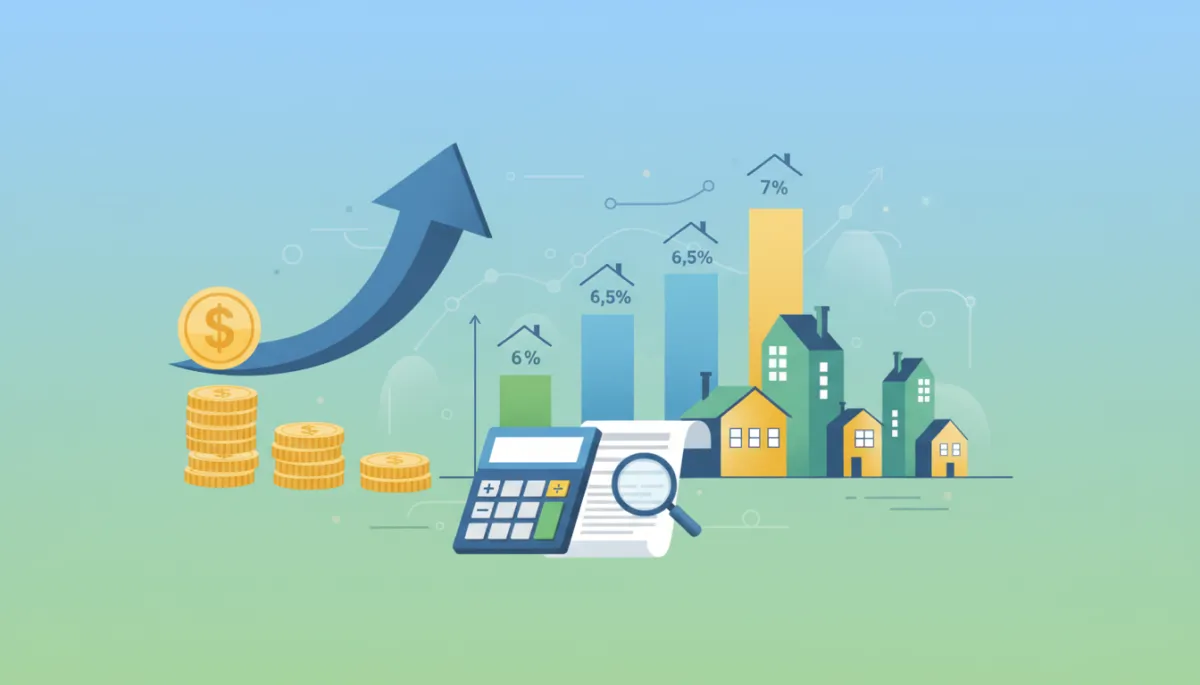
Impact of Interest Rates on Mortgage Payments
Home Loans, Mortgage Payments, Interest Rates
How Much Does Your Interest Rate Really Affect Your Monthly Payment?
As a loan officer, I hear this all the time: “I’m just going to wait until rates drop.” But how much does that rate actually change what you pay every month—and is waiting really worth it?
First, a Simple Look at How Your Payment Is Built
Your mortgage payment has a few pieces, but let’s keep it simple and focus on the core: principal + interest.
Principal is the amount you actually borrow for the home.
Interest is the cost the lender charges you to borrow that money, expressed as a percentage (your interest rate).
On a standard 30‑year fixed mortgage, your payment is calculated so that you pay back the principal and the interest over 360 months. When your interest rate goes up, more of that monthly payment goes toward interest and less toward principal—so the total payment increases.
💡 Quick mindset shift: Your rate matters—but your payment and overall plan matter more. You don’t live in an interest rate; you live in a monthly payment.
6% vs 6.5% vs 7%: How Big Is the Difference Really?
Let’s use a real‑world example. Say you’re looking at a home around $400,000 and putting 10% down. That means you’re borrowing roughly $360,000 on a 30‑year fixed loan.
Interest Rate Approx. Monthly (Principal & Interest) 6.0% ≈ $2,160 6.5% ≈ $2,275 7.0% ≈ $2,395
From 6% to 6.5%, that’s roughly a $115 per month difference. From 6.5% to 7%, it’s another about $120 per month. Over time that adds up, but month‑to‑month it’s often less dramatic than people imagine—especially compared to the cost of missing out on a home you love or watching prices rise while you wait.
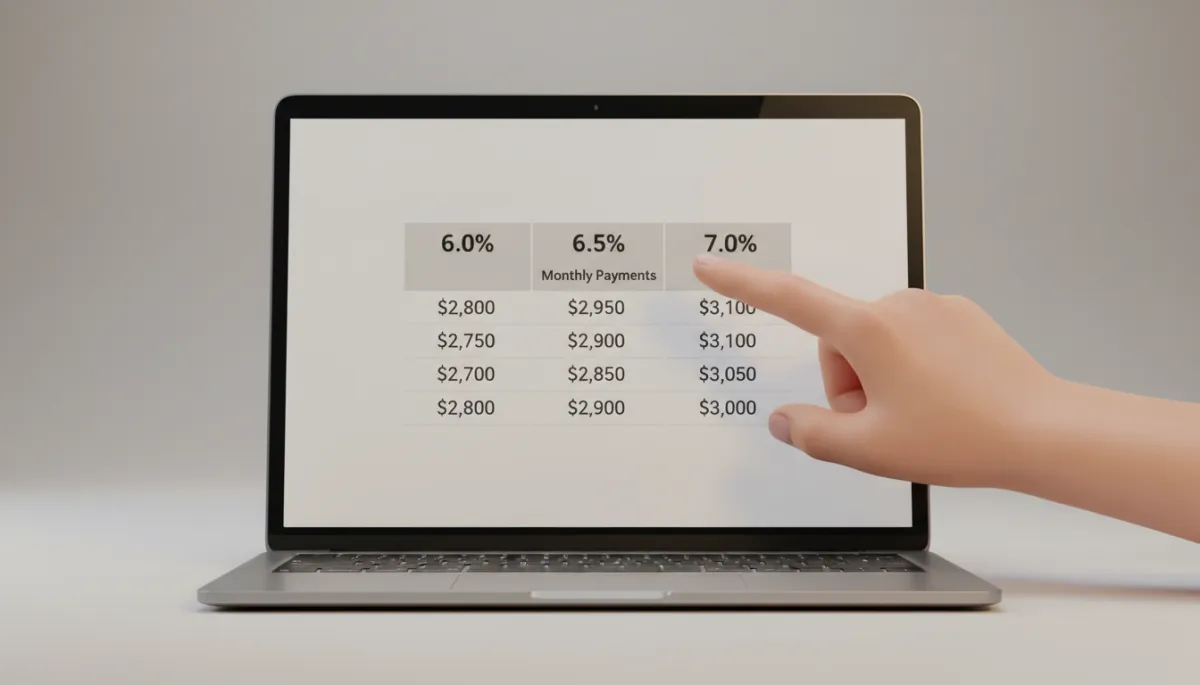
Small rate changes usually shift payments by hundreds, not thousands, per month.
What About Today’s Rates Around 6–6.5%?
As of late March 2026, the average 30‑year fixed mortgage rate is hovering around 6.4%–6.6%, with one recent data point at 6.422% for a 30‑year fixed loan (sources: Freddie Mac, Mortgage Bankers Association, Optimal Blue). So let’s use a 6.5% rate for some quick, realistic estimates.
How Much Does an Extra $10,000 Really Change the Payment?
Now let’s look at the question buyers ask right after rate talk: “If I go up a little in price, how much more is that per month?”
Using a 30‑year fixed mortgage at roughly 6–6.5%, a good rule of thumb is: every additional $10,000 in purchase price adds about $60–$70 per month to the principal and interest payment.
At ~6.0%, $10,000 adds roughly $60 per month.
At ~6.5%, $10,000 adds closer to $65–$70 per month.
So if you’re debating between a $390,000 home and a $410,000 home, you’re likely looking at roughly $120–$140 more per month in principal and interest. For many buyers, that’s the difference between one dinner out or a couple of streaming subscriptions—not an impossible jump.
The “I’m Waiting for Rates to Drop” Mindset
I completely understand the instinct to wait. Rates dipped below 6% for a bit, then climbed back into the mid‑6s as inflation and global events pushed them higher. It’s tempting to think, “I’ll just buy when they go back down.”
The challenge is: none of us control the market. While you’re waiting for the “perfect” rate:
Home prices in your area may keep rising.
You’re still paying rent—and 100% of that is interest to your landlord.
You might miss out on a home that actually fits your life right now.
💡 Smart approach: Buy when the payment works for your budget and life, then consider refinancing later if rates drop.
Strategy and the Right Loan Officer Matter More Than Timing the Market
Instead of chasing a headline rate, focus on an affordability strategy. That’s where a good loan officer earns their keep. Together, we can:
Dial in a comfortable monthly payment range for your budget.
Look at different down payment options and loan programs (conventional, FHA, 15‑year vs 30‑year, and more).
Explore strategies like seller credits or buying down the rate if it makes sense.
When you understand that a half‑percent rate change might mean around $100–$150 per month on a typical loan—and that an extra $10,000 in price might mean $60–$70 per month—you can make calm, informed decisions instead of fear‑based ones.
Your Next Step: Get a Personalized Payment Breakdown
If you’re staring at rate headlines and feeling stuck, you don’t need more noise—you need your numbers. What does a $375,000 home at 6.4% look like for you? What about $425,000 at 6.8%? How much room do you really have before the payment feels tight?
I’m happy to walk you through a clear, side‑by‑side breakdown of:
Different price points (for example, $350,000 vs $400,000 vs $450,000)
A range of rates (6%, 6.5%, 7%) based on current market conditions
How much each $10,000 and each 0.25% in rate really moves your payment
When you see it in black and white, the fear around rates usually shrinks, and a realistic plan comes into focus. That’s the goal: not a “perfect” rate, but a comfortable, sustainable payment that lets you own a home and still live your life.
If you’re curious what today’s rates around 6–6.5% mean for your specific situation, reach out. I’ll run a personalized payment breakdown—no pressure, no jargon—so you can decide with confidence whether now is the right time to move forward.


