Credit Card Rates Rise, Mortgage Rates Fall Post-Fed Hike
Personal Finance, Interest Rates, Homeowners, Credit Cards
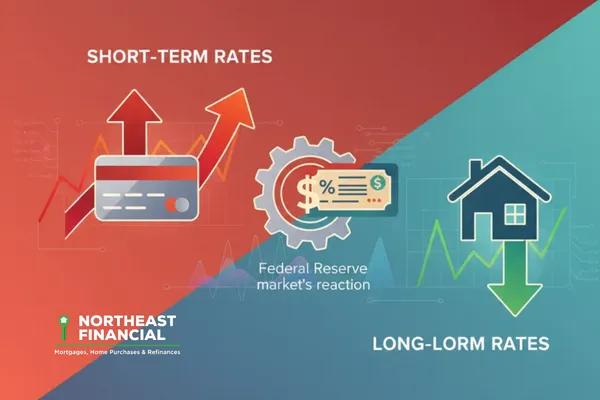
Why Your Credit Card Rate Jumped After the Fed Hike — But Mortgage Rates Eased
At Northeast Financial, we spend our days helping homeowners make sense of a fast‑moving rate environment. When the Federal Reserve makes a move, it doesn’t hit every part of your financial life the same way. Some rates react almost instantly, while others move more slowly — or even in the opposite direction. That’s exactly what we just saw after the Federal Reserve’s latest rate hike: credit card rates moved up, while mortgage rates actually drifted lower. In this article, we’ll walk you through why that happens and what it means for you as a homeowner.
Quick context: What the Fed just did — and why it matters
On September 16, 2026, the Federal Reserve raised its benchmark federal funds rate by 0.25 percentage points, bringing the target range to 3.75%–4.00% (AP News). This was the first hike since 2023, aimed at keeping persistent inflation in check and signaling that the Fed is still serious about price stability.
If you’re an everyday homeowner, you probably didn’t read the Fed statement line by line. What you did notice, though, is that your credit card APR crept higher — while headlines said mortgage rates were easing from recent peaks in the high‑6% to low‑7% range (Freddie Mac, Bankrate, FRED). That can feel contradictory, even unfair, if you’re juggling revolving debt and a mortgage at the same time. Our goal at Northeast Financial is to unpack that confusion so you can make smarter decisions with confidence.
The Fed’s rate is a short-term “reference variable,” not a master switch
Think of the federal funds rate as a key configuration value in a large financial system — a number that directly controls a specific part of the market and only indirectly influences everything else. The Fed sets the rate banks charge each other for overnight loans. That’s a short‑term rate, and it’s closely linked to other short‑term borrowing costs in the economy.
Most credit cards, home equity lines of credit (HELOCs), and many auto loans are tied to the prime rate, which usually moves almost in lockstep with the Fed’s rate — typically prime is the Fed funds rate plus about 3 percentage points (Boston Fed). When the Fed hikes by 0.25%, prime usually follows within a billing cycle, and your variable APRs recalculate accordingly.
💡 In plain English: The Fed’s rate is like changing a global setting that all short‑term loans reference. When that setting goes up, your credit card and HELOC rates “reset” higher almost automatically.
Why mortgage rates follow a different “program path”
Long‑term rates, like 30‑year and 15‑year fixed mortgage rates, live in a different part of the financial system. They’re not directly controlled by the Fed’s short‑term rate. Instead, they’re driven mainly by the bond market, especially the yield on the 10‑year U.S. Treasury note, plus a margin for risk and lender costs (Bankrate, Investopedia).
Bond market demand: When investors buy more long‑term Treasurys, prices go up and yields (interest rates) go down. Mortgage rates typically move in the same direction as the 10‑year Treasury yield.
Inflation expectations: If investors believe inflation will cool in the future, they’re willing to accept lower long‑term yields, pulling mortgage rates down, even if the Fed is raising short‑term rates today.
Economic growth outlook: Signs of slower growth or a potential slowdown often push money into safer assets like Treasurys, lowering yields and easing mortgage rates.
Global factors: Overseas investors, geopolitical risk, and foreign central bank policies can all increase demand for U.S. bonds, again pushing long‑term yields — and mortgage rates — lower (Forbes, Bankrate).
After the September 2026 hike, markets interpreted the move as the Fed getting closer to the end of its tightening cycle and potentially keeping inflation in check. That lowered future inflation expectations and nudged investors toward long‑term bonds. Result: the 10‑year Treasury yield eased, and mortgage rates, which had been hovering in the high‑6% to low‑7% range, saw some relief even as your credit card APR ticked higher.
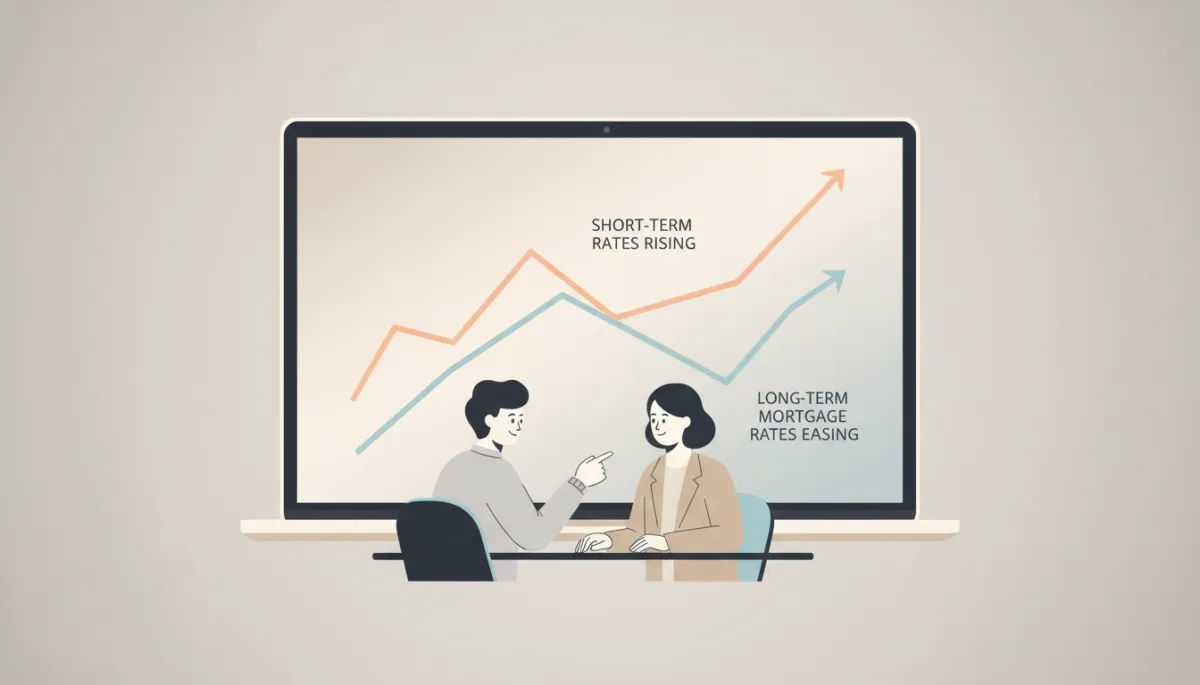
Short‑term borrowing costs can rise even while long‑term mortgage rates drift lower.
A simple breakdown: how short-term and long-term rates behave differently
You don’t need to be a financial expert to understand what’s going on. Think of your debts in two broad buckets, each reacting differently when the Fed moves:
Bucket 1: Short‑term, “everyday” borrowing (credit cards, many HELOCs, some auto loans). These are closely tied to the Fed’s rate. When the Fed raises rates by 0.25%, your credit card APR usually climbs by about the same amount within a month or so.
Bucket 2: Long‑term, “big life” borrowing (30‑year and 15‑year fixed mortgages). These follow the bond market and expectations about future inflation and growth — not the Fed’s short‑term rate directly. That’s why mortgage rates can drift lower even when your card rate is rising.
📌 Key idea:Short‑term loans listen to what the Fed is doing today. Long‑term loans care more about what investors think will happen over the next 5–10 years.
Short‑term products like credit cards are essentially “plugged in” to the Fed’s rate. Long‑term products like mortgages are “plugged in” to the 10‑year Treasury yield, inflation expectations, and the overall economic outlook. That’s why they can move in opposite directions after the same Fed decision.
How rising credit card APRs quietly inflate your monthly costs
As of mid‑2026, the average credit card APR on accounts carrying a balance was already around 22.15% (WalletHub, Philadelphia Fed). When the Fed hikes by 0.25%, that often means your variable APR rises by roughly the same amount — for example, from 22.00% to about 22.25% (CNBC, Boston Fed).
On a $5,000 balance, that specific hike adds roughly $12.50 per year in extra interest by itself. That may sound small, but remember:
You’re already paying a high rate to begin with — over 20% is common.
If the Fed raises rates multiple times, those “small” bumps compound.
Many cardholders only make minimum payments, so balances linger for years, magnifying interest costs.
The Boston Fed found that a 1‑percentage‑point increase in APR leads to an average 8.7% drop in card spending the next month — and for people who carry balances (“revolvers”), spending falls by about 15%. That’s a sign that higher rates really do squeeze household budgets, especially for those already under strain.
A quick interest cost comparison in everyday numbers
To see how big the gap can be, imagine you owe $10,000 and you carry that balance for a full year without paying it down, just to compare interest costs:
On a credit card at 22% APR: you’d pay about $2,200 in interest in one year.
On a home‑equity loan or HELOC at 8%: you’d pay about $800 in interest in one year.
That’s a difference of roughly $1,400 in a single year on the same $10,000 balance. Stretch that over several years, and the extra cost of keeping debt on a high‑rate credit card becomes painfully clear.
💡 Simple rule of thumb: If you’re carrying balances for more than a few months, the interest rate matters a lot. Moving debt from a rate in the 20% range to something in the single digits can free up real money in your budget.
This simple math shows why high‑APR revolving debt is so punishing — and why replacing it with a lower‑rate, secured loan can meaningfully reduce your interest costs over time, even if mortgage and HELOC rates are in the mid‑single digits.
Practical takeaway: Separate your “short-term pain” from your “long-term plan”
Understanding the difference between short‑term and long‑term rates helps you respond calmly instead of reacting in fear. Here’s how we encourage our clients at Northeast Financial to think about it as homeowners and consumers:
Treat credit card debt as an emergency bug, not a feature. High‑APR balances are like a constant drain on your monthly cash flow — they quietly eat into the money you could be saving or investing elsewhere. Prioritize paying them down or restructuring them.
Recognize that your mortgage lives on a different clock. If you already have a fixed‑rate mortgage, the Fed’s latest move doesn’t change your payment. Future refi opportunities will depend more on bond yields, inflation trends, and economic data than on any single Fed meeting.
Use your home equity strategically. If you have equity, you may be able to swap high‑interest revolving debt for a lower‑rate, structured loan.
How Northeast Financial can help: second mortgages and HELOCs for debt consolidation
This is where a trusted lender like Northeast Financial can be a real ally. If you’re a homeowner sitting on equity but feeling crushed by rising credit card APRs, consolidating that debt into a second mortgage or HELOC can simplify your finances and potentially reduce your total interest cost.
Second mortgage: A lump‑sum loan secured by your home, with a fixed rate and fixed term. You use the funds to pay off high‑rate cards, then make one predictable monthly payment.
HELOC (Home Equity Line of Credit): A revolving line secured by your home. You can draw what you need to pay down card balances, then focus on aggressively paying the HELOC at a much lower rate than your cards.
📌 Key takeaway: You’re not powerless when the Fed raises rates. By consolidating high‑APR debt into a lower‑rate home‑equity product, you can turn a rising‑rate environment into an opportunity to clean up your balance sheet.
Next step: Talk through your numbers with a professional
Just like you wouldn’t make a major life decision without looking at the details, you shouldn’t make a major financial move without running the numbers. A second mortgage or HELOC isn’t right for everyone — you’re securing debt against your home, and you need a realistic plan to pay it down. But for many households carrying multiple cards at 20%+ APR, it can be a powerful way to regain control.
If you’re a homeowner feeling the squeeze from rising credit card rates after the Fed’s latest hike, consider reaching out to Northeast Financial to review your options. Our team can walk you through potential second mortgage or HELOC solutions, compare payments, and help you decide whether consolidating high‑interest balances into a lower‑rate home‑equity product makes sense for your situation.
You can’t control the Fed, the bond market, or inflation. But you can control how your debt is structured. Understanding the difference between short‑term and long‑term rates — and using your home equity wisely — is a practical, concrete way to protect your household from rising credit card APRs and move toward a more stable financial future. At Northeast Financial, we’re here to help you take that next step with clarity and confidence.


