
First Home Buyer: Rent vs Buy Dilemma
First Home Buyer, Home Buying Tips, Rent Vs Buy, Real Estate Market, Savings Mistake, Housing Appreciation
The $600K First Home: A Real Conversation About Rent, Savings, and Missing the Market
A behind-the-scenes look at a young First Home Buyer wrestling with the classic Rent Vs Buy dilemma—while Northeast home prices quietly climb away from him.
A Young Buyer, Big Ambitions, and a $600K Goal
Recently, I sat down with a young, up-and-coming professional—let’s call him Alex—who’s preparing to purchase his first home in the $600,000 price range. Alex is exactly the kind of person you picture when you hear the phrase First Home Buyer: ambitious, financially responsible, and determined not to make a mistake with the biggest purchase of his life.
He already has a healthy savings account and a solid job. His credit is strong. On paper, he’s ready. But mentally, he’s stuck on one idea: he wants to put 50% to 60% down before buying. On a $600K home, that’s $300,000 to $360,000 in cash.
“If I can just save a little longer,” he told me, “I’ll feel safer with a huge down payment. No big mortgage hanging over my head.” It sounds responsible—and in many ways, it is. But in today’s Real Estate Market, especially in the Northeast, that plan can quietly turn into a Savings Mistake that costs far more than he realizes.
The $2,000 a Month Problem: Rent With Nothing to Show for It
Right now, Alex rents a modest apartment for $2,000 a month. That’s $24,000 a year—money that keeps a roof over his head but builds zero equity. No principal paydown, no tax benefits, no share in the region’s Housing Appreciation. Just a receipt and a lease renewal notice every year.
Over one year, that’s:
$2,000 × 12 months = $24,000 gone, with nothing to show for it.
Over two years, it’s $48,000. Over three years, that number jumps to $72,000. That’s the quiet cost of waiting on the sidelines in the Rent Vs Buy debate. And remember, this doesn’t even include the likely rent increases the Northeast is known for; many forecasts expect annual rent bumps in the 4–5% range in 2026 alone, according to the National Apartment Association.
💡 Pro Tip: Rent is not “throwing money away” if you truly need flexibility—but when you’re financially ready to buy, each extra year of renting is a real, measurable cost.
Meanwhile, the Northeast Market Keeps Moving
Now layer in what’s happening to home prices. The Northeast has been one of the strongest regions in the country. Recent data from the National Association of REALTORS® shows existing home prices in the region rising around 4% to nearly 6% year over year, with some months and metros pushing closer to that 8% appreciation mark. Other reports, like Clear Capital’s Home Data Index, confirm a similar pattern of steady price growth in 2026.
For simplicity, let’s assume Alex’s $600,000 target home appreciates somewhere between 4% and 8% annually—well within the observed and forecast range for the Northeast Real Estate Market in 2026. What happens if he waits?
One Year of Waiting
4% appreciation: $600,000 × 1.04 = $624,000
8% appreciation: $600,000 × 1.08 = $648,000
In one year, the same style of home could cost Alex $24,000 to $48,000 more—on top of the $24,000 he paid in rent. His “wait and save” strategy could easily cost him $48,000 to $72,000 in combined rent and price increases in just twelve months.
Two to Three Years of Waiting
Stretch that to two or three years, and the numbers get more dramatic. Using a conservative 4% annual appreciation:
After 2 years at 4%: $600,000 × 1.04² ≈ $648,960
After 3 years at 4%: $600,000 × 1.04³ ≈ $675,918
At the higher 8% appreciation rate:
After 2 years at 8%: $600,000 × 1.08² ≈ $699,840
After 3 years at 8%: $600,000 × 1.08³ ≈ $755,827
Meanwhile, Alex’s rent over those same periods:
2 years of rent: $48,000
3 years of rent: $72,000
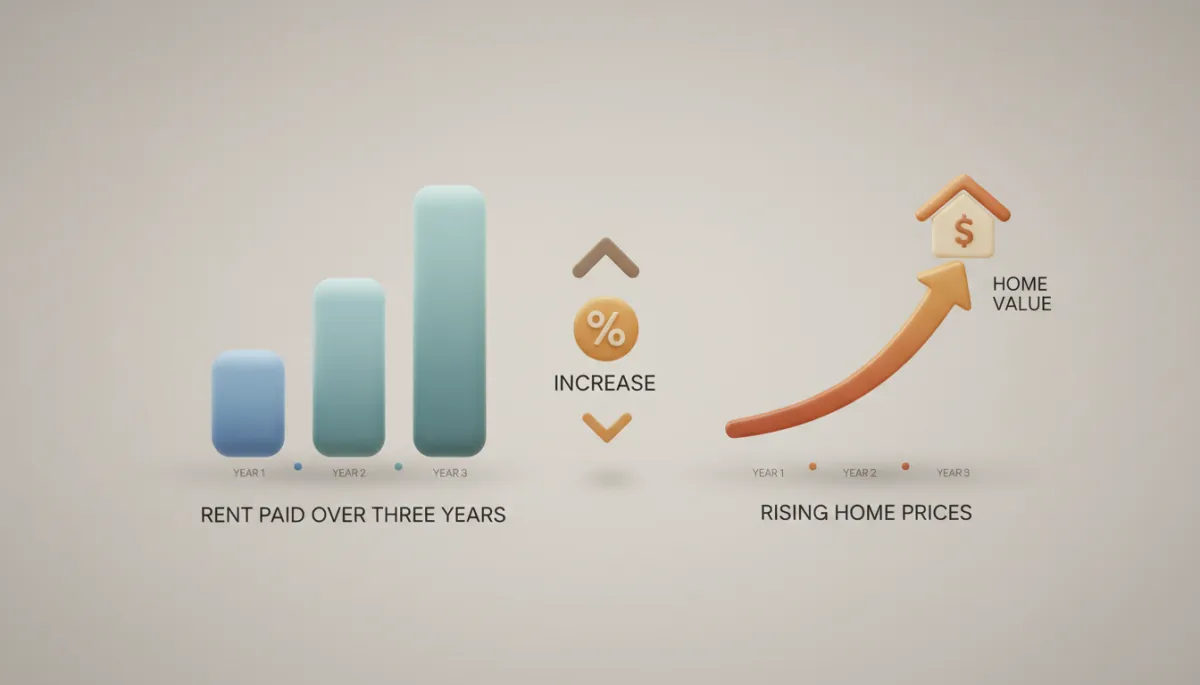
Over just a few years, rent plus appreciation can outpace even aggressive savings.
The Carrot on the End of a Stick: Chasing the “Perfect” Down Payment
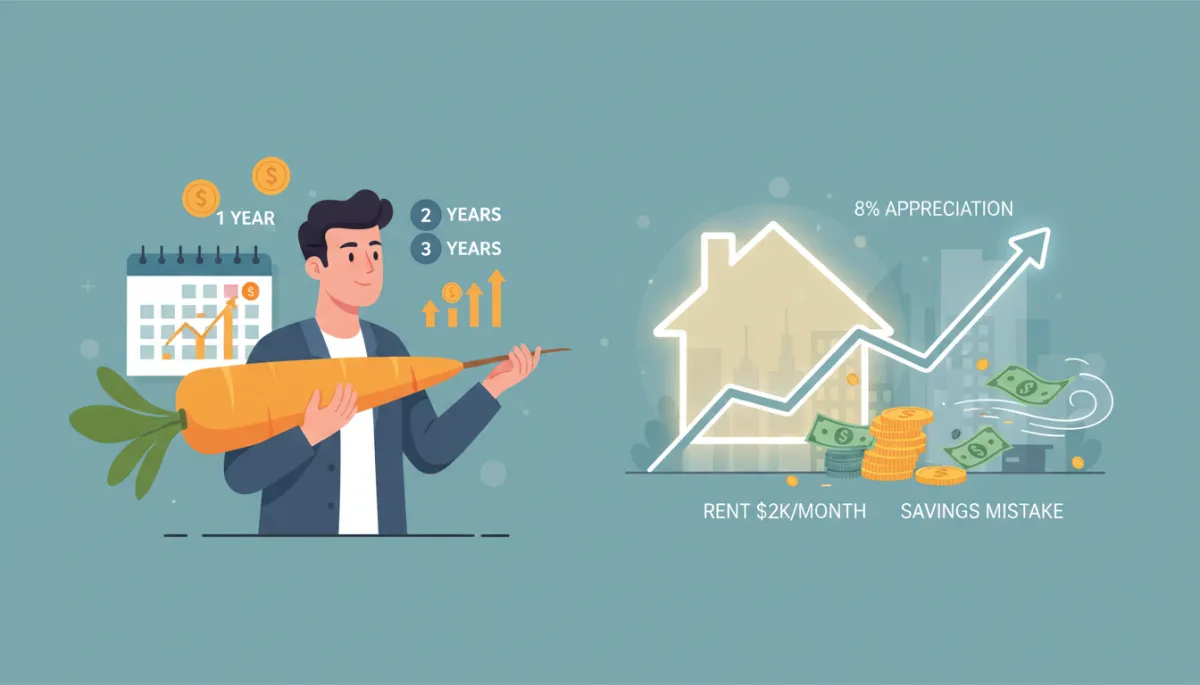
As we walked through these numbers, Alex grew quiet. His plan to save until he had 50% or 60% down suddenly looked less like a smart strategy and more like the classic carrot on the end of a stick. The closer he tries to get, the farther it moves away from him, because the target home keeps getting more expensive each year.
Think about it this way: if Alex wants to put 50% down on a $600,000 home, that’s $300,000. But if he waits three years and that same home is now worth $700,000, his 50% target is suddenly $350,000. He’s chasing a moving goalpost while losing money to rent and missing out on appreciation he could have been earning as an owner.
📌 Key Takeaway: Saving more is good—but if prices are rising faster than your savings, you may be moving backward, not forward.
The Real Savings Mistake: Waiting on the Sidelines
When people talk about a Savings Mistake in the context of Home Buying Tips, they often focus on lifestyle spending—too many dinners out, not enough discipline. But for buyers like Alex, the bigger mistake isn’t how they spend; it’s how long they wait while the market moves without them.
In a region where home prices have climbed around 4–6% year over year, with some pockets closer to 8%, the cost of waiting can easily reach tens—or even hundreds—of thousands of dollars over a few years. That’s before considering the equity he could have built through regular mortgage payments during that same time frame.
Meanwhile, the Rent Vs Buy trade-off shifts. As rents in the Northeast continue to rise modestly now, with forecasts of stronger growth later in 2026, the monthly gap between renting and owning narrows. In some markets, owning with a reasonable down payment can already be comparable to renting—except ownership locks in your housing cost and lets you share in future appreciation.
Rethinking the Down Payment: From 60% to Smart and Strategic
None of this means Alex—or any First Home Buyer—should rush into a purchase unprepared. But it does suggest rethinking the idea that you need a 50% or 60% down payment to be “safe.” In many cases, a well-structured 10% to 20% down payment, backed by a solid emergency fund and stable income, can be far more realistic and financially sound than waiting years to hit a nearly impossible savings goal.
For Alex, the question shifted from “How do I save enough to avoid a big mortgage?” to “How do I balance a comfortable payment with the reality of rising prices?” That’s a healthier, more strategic version of the Home Buying Tips conversation—and one that recognizes the true cost of time in a rising Real Estate Market.
💡 Pro Tip: Talk to a lender early. Seeing real numbers for different down payments and interest rates can be far more helpful than guessing—and may show you that you’re closer to ready than you think.
Bringing It All Together: What Alex—and You—Can Learn
By the end of our conversation, Alex saw his situation differently. Yes, saving is important. Yes, a larger down payment can reduce monthly costs and long-term interest. But in a Northeast market appreciating between roughly 4% and 8% a year, while he pays $2,000 a month in rent, the real risk isn’t buying “too early.” It’s waiting too long and letting the market run away from him.
The carrot of a 50% or 60% down payment may always be just out of reach if prices keep rising. But ownership, even with a more modest down payment, can bring stability, equity, and a share in that same appreciation that’s currently working against him as a renter.
If you’re a First Home Buyer in a similar position—earning well, renting comfortably, and waiting for the “perfect” savings number—take a closer look at the math. Add up your rent over 1, 2, and 3 years. Compare it to realistic appreciation rates in your local market. Then ask yourself: Is waiting really safer, or is it quietly becoming my biggest Savings Mistake?
In today’s Northeast Real Estate Market, time is not neutral. It either works for you—or it works against you. The key is deciding which side of that equation you want to be on.


