
Should You Wait for Mortgage Rates to Drop?
Mortgages, Home Buying, Interest Rates
Should You Wait for Mortgage Rates to Drop in 2026? (Real Numbers Breakdown)
If you’re thinking about buying a home, you’re probably wondering: What are mortgage rates right now, will they go down, and should I wait until 2026? Let’s walk through today’s numbers, realistic expectations for the next couple of years, and exactly how much a 0.5% rate change could cost—or save—you.
1. What are mortgage rates right now—and will they go down?
As of April 24, 2026, national averages put mortgage rates here:
30-year fixed (purchase): roughly 6.1%–6.25% (Fortune and CBS News data based on Optimal Blue locks)1,2
15-year fixed (purchase): about 5.60%–5.63%1,2
Refinance rates are a bit higher, with 30-year refis averaging around 6.53% and 15-year refis near 5.64%.2 These are national averages, so your personal rate will depend on your credit score, down payment, loan size, and property type.
Will they go down from here? Many economists expect rates to gradually ease if inflation keeps cooling and the Federal Reserve cuts rates—but most major forecasts (Bankrate, Forbes, Investopedia) emphasize that the outlook is uncertain and big drops are not guaranteed.3,4,5
💡 Key idea: We’re no longer at the ultra-low 3% era, but also not at the 7–8% peaks. We’re in a “middle” zone where small moves still matter.
2. Will mortgage rates drop in 2026?
No one can promise what rates will be in late 2026, but we do know what will influence them:
Inflation: If inflation continues to cool toward the Federal Reserve’s 2% target, that supports lower mortgage rates.
Federal Reserve policy: Fed rate cuts usually put downward pressure on mortgage rates, but the relationship isn’t one-to-one.
Overall economy: A slowing economy or recession can also nudge long-term rates lower as investors seek safer bonds.
Expert forecasts generally suggest rates could stabilize or drift modestly lower over the next couple of years if inflation stays controlled.3,4,5 But it’s unlikely we’ll snap back to 3% anytime soon. Think more in terms of:
30-year rates moving between, say, the 5%–6.5% range—not 2.5%–3.5%.
📌 Bottom line on 2026: A modest drop is possible, but planning your entire home-buying strategy around a specific future rate is risky.
3. How much does a 0.5% change actually cost me?
Let’s use a simple, realistic example: a $300,000 loan on a 30-year fixed mortgage.
We’ll compare:
Scenario A: 6.00% interest rate
Scenario B: 6.50% interest rate (0.5% higher)
Scenario Rate Monthly Principal & Interest Total Interest Over 30 Years A – Lower rate 6.00% ≈ $1,799/month ≈ $347,640 B – 0.5% higher 6.50% ≈ $1,896/month ≈ $382,560
That 0.5% difference means:
About $100 more per month (roughly $85–$100 is a common rule of thumb on a $300,000 loan).6
About $35,000 more in total interest over 30 years.
📌 Translation: A 0.5% move is not pocket change—but it’s also not the only factor that determines whether buying now makes sense.
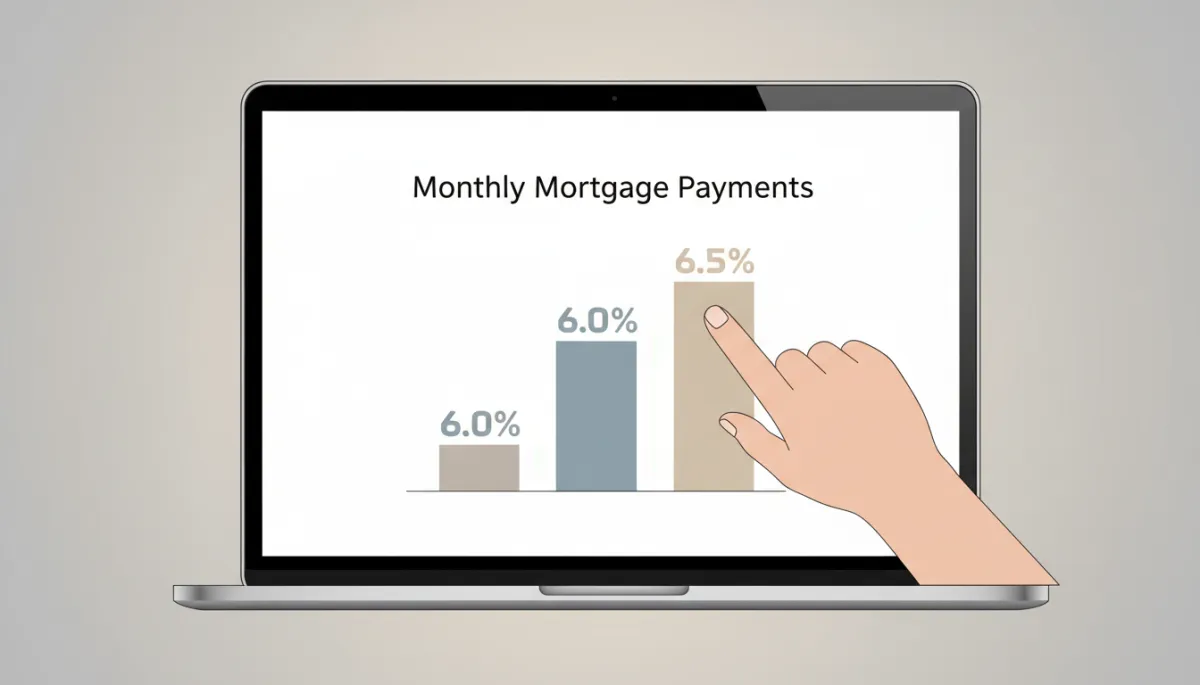
A half-point rate change can add tens of thousands in interest over time.
4. Should I buy now or wait for lower rates in 2026?
The real question isn’t just “Will rates drop?” but “What does waiting actually do to my total cost and my life?” Here are the key trade-offs to consider.
Reasons to consider buying now
You start building equity sooner. Each payment chips away at your principal instead of going entirely to rent.
Home prices could keep rising. Even if rates dip, higher prices might cancel out a lower rate—and you could face more buyer competition.
You can refinance later. If rates fall meaningfully, many homeowners simply refinance to capture the savings.
Reasons to consider waiting
You need time to strengthen your finances. Extra months to improve your credit score, pay down debt, or save a larger down payment can lower your rate and your monthly payment—regardless of where national averages land.
Your local market is softening. In some areas, prices or competition may be easing, giving you more negotiating power later.
💡 Practical rule of thumb: If you find a home you love that fits a conservative budget at today’s rate, it can make sense to buy now and treat any future rate drop as a bonus, not a requirement.
How to decide what’s right for you
Run the numbers at multiple rates. Ask a lender or use a calculator to compare payments at, say, 5.75%, 6.25%, and 6.75% on your target price range.
Stress-test your budget. Could you handle a slightly higher payment if rates tick up before you lock?
Weigh lifestyle factors. Sometimes the value of owning your own place—stability, space, location—outweighs the potential savings of waiting for a perfect rate.
In short, waiting for 2026 only makes sense if it clearly improves your overall picture—not just your interest rate. Focus on what you can control now: your credit, your savings, and choosing a home that keeps your monthly payment comfortable at today’s realistic rates.
Sources: (1) Fortune, current mortgage rates as of April 24, 2026; (2) CBS News, mortgage and refinance rate snapshots, April 24, 2026; (3) Bankrate, mortgage rate predictions; (4) Forbes Advisor, mortgage rate forecasts; (5) Investopedia, mortgage rate outlook; (6) Bankrate, “How mortgage rates affect monthly payments.”


